
Jefferson County Release Dates
Four dates are often confused. Release eligibility is the point when the law permits parole consideration or another release mechanism. A projected or calculated date is an agency computation based on the judgment, credits, and facts then known. Sentence expiration marks the end of the sentence calculation. Actual release is the physical custody event recorded by the agency, and it can lead to the community or to another custodian.
A Jefferson County pretrial detainee usually has no computed prison release date. Bond, recognizance, a dismissal, a court order, or a detainer may control the exit. A sentenced county inmate may have jail credit and a local release calculation. A person transferred to TDOC enters the state sentence system, even though the county roster no longer shows that person.
- Eligibility date
- The first point when consideration may be lawful, not a release promise.
- Projected date
- A current administrative estimate based on the sentence record.
- Expiration
- The calculated end of the sentence.
- Detainer
- A request or hold from another authority that can cause transfer instead of community release.
Find Jefferson Inmate Release Dates
Start by deciding whether the person is in county, state, or federal custody. The Jefferson County Jail holds pretrial detainees, locally sentenced people, prisoners awaiting state transfer, and some federal detainees tied to the U.S. Marshals Service. Each path has its own date record. Searching the wrong system can make an ordinary transfer look like release.
- Check the Jefferson County detention source for current local custody. An absent name is not proof of release.
- For a local case, obtain the judgment, bond order, dismissal, probation order, and any jail-credit order from the court clerk.
- Ask the jail whether the person remains held, was released to the community, or was transferred, and request the exit record.
- For a TDOC sentence, open FOIL and search by TDOC number when available, then compare identity and offense fields.
- Copy the date label exactly from the detail. Do not rename eligibility or expiration as a projected release date.
- For federal custody, use the BOP locator after designation or the federal court and Marshals route before designation.
The official TDOC FOIL gateway is the state route matched to projected-release research.
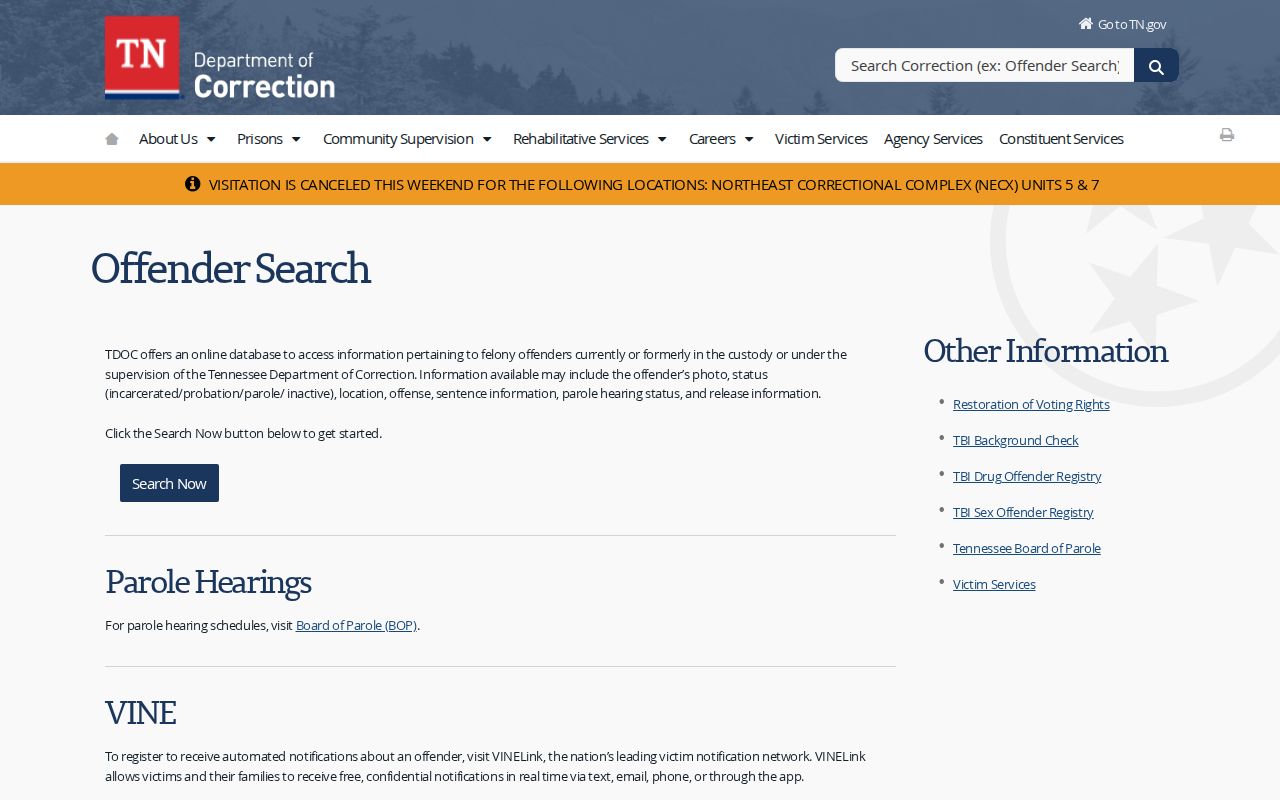
The gateway explains FOIL's scope for current and former felony offenders, which makes it useful after a Jefferson County defendant enters or leaves state custody.
The Jefferson County released-inmate record route covers the county release log and court cross-check when FOIL is not the right source.
Note: Preserve the date label, status, source agency, and retrieval date so later changes can be compared without altering the original record.
Jefferson FOIL Release Labels
TDOC says FOIL may show sentence and release information, but it does not promise that every detail contains a field named “projected release date.” A live result might state release eligibility, sentence expiration, status, location, or another exact label. Use the wording on that record. A parole eligibility date shows when consideration can occur. It does not show a guaranteed gate date.
FOIL covers felony offenders currently or formerly in TDOC custody or under state supervision. It may display incarcerated, probation, parole, or inactive status. Probation and parole mean the person is outside prison but remains under state authority. Inactive status requires context from sentence, release, and court records. A misdemeanor-only booking, short pretrial stay, bond-out, or dismissed Jefferson County case may never appear in FOIL.
| FOIL item | How to read it |
|---|---|
| Status | Current state custody or supervision category, copied verbatim |
| Location | The state institution or supervision information shown |
| Sentence information | The recorded state sentence details, not a county jail computation |
| Release information | The exact date and label supplied on the live detail |
| Parole-hearing status | A Board process indicator, not physical release |
Tennessee Release Date Calculation
The state calculation begins with the court judgment and the law in effect when the offense occurred. TDOC then accounts for the imposed term, certified jail credit, the statutory release-eligibility percentage, whether credits are permitted, credits actually earned or lost, and concurrent or consecutive sentences. Parole rules, mandatory reentry provisions, amended judgments, and holds from other jurisdictions can also matter. A private arithmetic estimate cannot replace that operational computation.
Tenn. Code Ann. § 40-35-501 contains general and offense-specific eligibility rules. In older or nonspecial sentence structures, familiar classifications may use 20 percent for especially mitigated, 30 percent for standard, 35 percent for multiple, 45 percent for persistent, and 60 percent for career offenders. Offense-specific rules, offense dates, exclusions, and higher service requirements can displace those figures.
Tenn. Code Ann. § 41-21-236 governs sentence-reduction credits. Credits are not a flat discount from every sentence. Jail credit, sentence-reduction credit, program-performance credit, and parole eligibility are separate concepts. They should not be combined without the judgment and the applicable statute. TDOC controls the state calculation.
Jefferson Release Percentage Rules
Public Chapter 988 changed Tennessee truth-in-sentencing rules for specified offenses committed on or after July 1, 2022. One group must serve 100 percent without sentence-reduction credits changing release eligibility. The official summary includes attempted first-degree murder, second-degree murder, intoxication vehicular homicide, aggravated vehicular homicide, especially aggravated kidnapping, especially aggravated robbery, carjacking, and especially aggravated burglary.
A second listed group has a term imposed at 100 percent but may use satisfactory program-performance credits to reduce the share served before parole eligibility by no more than 15 percent. That creates the common “85 percent” shorthand. It does not shorten sentence expiration, and it is not a rule for every Tennessee prisoner or every violent offense. The precise offense subsection and date must be checked in the current law.
The General Assembly's 2022 Public Chapter summary also explains Public Chapter 952. For sentencing hearings on or after July 1, 2022, a court imposing continuous confinement states an estimated time before release eligibility. That courtroom estimate is explanatory. It does not replace TDOC's later sentence administration.
The sentencing estimate also cannot serve as a direct appeal or post-conviction basis under the official summary. Its role is to describe likely eligibility at the hearing. Later earned or lost credits, corrected judgments, consecutive terms, Board action, and holds remain part of the operational record. For a Jefferson County defendant, keep the estimate with the signed judgment, then compare both with the current TDOC calculation.
Note: Eligibility means the law permits consideration; it does not require the Board of Parole to grant release on that date.
Jefferson Release Date Changes
A future date is a snapshot. New data can move it earlier or later, and a change may reflect a lawful correction rather than an error. Compare the current FOIL record with the judgment and any later order. When the result remains unclear, request the existing TDOC sentence computation or discharge record using the TDOC number.
| Factor | Possible effect | Record to check |
|---|---|---|
| Credits earned, withheld, or lost | Changes an eligible calculation where credits apply | TDOC sentence record |
| Corrected jail credit | Changes time credited toward the sentence | Court order and TDOC computation |
| Concurrent or consecutive terms | Combines sentences in different ways | Judgments and sentence summary |
| Parole denial, deferral, or rescission | Prevents an expected parole release | Board decision and FOIL |
| Detainer or hold | Causes transfer when TDOC custody ends | Release record and receiving agency |
| Amended or appellate order | Changes the legal sentence basis | Current court file |
TDOC Policy 511.03 describes institutional release categories and detainer processing. A parole grant still requires field-office approval of a release plan and can be rescinded before the person leaves. If another authority has a valid hold, the end of TDOC custody can lead straight to that agency rather than the community.
Jefferson County Jail Release Date
Do not apply TDOC prison credits to a Jefferson County jail sentence by assumption. Obtain the judgment and any jail-credit order from the Circuit and General Sessions Court Clerk. Then ask the jail for the controlling release record. The court order explains the legal sentence; the jail record shows the actual exit time and destination.
Pretrial custody follows a different path. A bond can permit release while the case continues. A dismissal may end one charge while another hold remains. A “time served” judgment can still require processing or resolution of a separate case. If the person leaves the current roster, ask whether the event was release, state transfer, federal transfer, or movement to another county.
Jefferson County research did not establish a local jail good-time formula, daily release hour, weekend-release rule, or fixed web-retention period. Those gaps should not be filled with a rule from another Tennessee county. The jail and clerk can identify the existing records that govern the individual case.
A narrow local inquiry should name the person, date of birth, approximate booking date, and booking number when known. Ask for the existing booking and release timestamps, release authority, and destination. If staff cannot answer by phone, use the county public-record process. A court docket can show that an order was entered, but only the jail event record establishes when processing ended.
Confirm Jefferson Inmate Release
Actual release needs a changed custody status and an agency exit record. For a state prisoner, compare the live FOIL status with TDOC's release or discharge record. For a county inmate, use the jail release log plus the court order. If the destination names another agency, custody continued even though one facility's record ended.
VINELink can add an alert for a pending custody change. Its automated message can lag and does not replace the official record. The Jefferson County VINELink release check explains how to match one person, register securely, and read the source agency. Keep the notification PIN and contact data private.
A parole schedule, eligibility date, or Board grant also falls short of actual release. TDOC must approve the release plan, and a later hold or rescission can intervene. Record the date type, source, status, and retrieval time. That small audit trail prevents a projected calculation from being reported as a completed Jefferson County release.